
Unvented Cylinder InstallationAnd Servicing Across EssexDone Under G3 Qualification
An unvented cylinder gives you mains-pressure hot water at every tap and shower without a loft tank — but only when it is sized, installed and discharged correctly. FHP Heating installs, services and repairs unvented hot water cylinders under G3 and Water Regulations qualifications, tests every safety device, and hands you the paperwork that proves it.
Gas Safe Register No. 6075146 · G3 unvented and Water Regulations qualified · 12-month workmanship guarantee.
G3
Unvented hot water qualified
6075146
Gas Safe Register number
12 months
Workmanship guarantee on every job
£2 million
Public liability insurance
24/7
Phone answered, seven days a week
Mains-pressure hot water, installed to Building Regulations Part G3
An unvented hot water cylinder is a sealed, pressurised store of hot water fed directly from the cold mains, so every outlet in the property runs at mains pressure rather than relying on gravity from a loft tank. FHP Heating installs, services, repairs and replaces unvented cylinders on domestic and commercial properties across Essex, working under Gas Safe registration 6075146 alongside G3 unvented cylinder and Water Regulations qualifications.
What the work actually involves
Checking the incoming mains flow rate and static pressure to confirm an unvented system will perform, sizing the cylinder to the number of bathrooms and the household's hot water demand, siting it where the discharge pipework can be run legally, fitting the cylinder with its full safety group — expansion vessel, pressure reducing valve, expansion relief valve and temperature and pressure relief valve — running the tundish and D2 discharge to a safe termination, wiring the immersion and thermostatic controls, then commissioning, temperature-testing and issuing the Benchmark and building notification paperwork.
Who it is for
Homeowners with more than one bathroom who are tired of weak showers, anyone removing loft tanks to convert a loft or reclaim space, households moving from a gravity-fed vented cylinder to a system or regular boiler with stored mains-pressure hot water, landlords whose existing cylinder has no service history, and commercial premises that need a reliable stored hot water supply.
When it is needed
When hot water pressure is noticeably weaker than cold, when a shower pump is masking a gravity-fed system that cannot keep up, when an existing unvented cylinder is leaking from the tundish, running lukewarm, or has never been serviced, when a cylinder is beyond economic repair, or when a new bathroom or en-suite is being added and the current cylinder cannot supply it.
Why a G3 qualified engineer matters here
An unvented cylinder stores water above 60°C under mains pressure. If the safety devices fail and nothing relieves that pressure, the stored energy is genuinely dangerous — which is why installation of an unvented system is notifiable work under Building Regulations Part G3 and must be carried out by a qualified operative. FHP Heating holds the G3 unvented cylinder and Water Regulations qualifications required for this work, is Gas Safe registered under 6075146 for the boiler and control side, and carries £2 million public liability insurance.
An unserviced unvented cylinder is a pressure vessel nobody has checked
Unvented cylinders fail quietly. The expansion vessel loses its charge, the relief valves start passing, the discharge drips into the tundish, and because there is still hot water at the taps nobody calls anyone — until the day there is water on the floor, a scalding risk, or a cylinder that has to be replaced years earlier than it should have been.
A flat expansion vessel forcing water out of the relief valve
The expansion vessel absorbs the increase in volume as water heats. When its air charge is lost, that expansion has nowhere to go, so pressure spikes on every heating cycle and the expansion relief valve dumps water through the tundish. Left alone, the valve seat erodes and the discharge becomes constant.
Water metered away down the drain
A passing relief valve discharges heated mains water to the outside. On a metered supply that is water you pay for twice — once at the meter and once in the gas or electricity used to heat it — running twenty-four hours a day until someone notices.
Scalding risk from a failed thermostat
If the control thermostat sticks and the overheat cut-out has never been tested, stored water can climb well past its intended temperature. The temperature and pressure relief valve is the last line of defence, and it is exactly the component an annual service exists to verify.
Discharge pipework that cannot do its job
A D2 discharge that is undersized, too long, run in unsuitable material or terminated somewhere unsafe means that in the one event the whole safety chain exists for, near-boiling water is not taken away safely. This is one of the most common faults we find on cylinders installed by unqualified fitters.
Limescale shortening cylinder life
Much of Essex sits on hard water. Scale builds on the internal heat exchanger coil and immersion element, so recovery slows, the boiler runs longer for the same hot water, and the cylinder is eventually condemned for performance rather than a fixable fault.
No paperwork when you sell or let the property
An unvented installation should be notified to building control and recorded in the Benchmark log, with servicing entries kept up. Missing records surface at the worst moment — during a sale, a letting inspection or an insurance claim.
Mistakes that make the bill bigger
- Fitting an unvented cylinder without first measuring the mains flow rate, then blaming the cylinder for poor performance.
- Undersizing the cylinder for the number of bathrooms, so hot water runs out mid-shower every evening.
- Allowing unqualified labour to install or service an unvented system, which is unlawful and uninsurable.
- Running the tundish discharge into a soil stack or terminating it where a person could be scalded.
- Skipping the annual service, so the expansion vessel charge and relief valves are never checked.
- Ignoring a dripping tundish because there is still hot water at the taps.
How FHP Heating handles unvented cylinder work
Every unvented job starts with measurement, not assumption. We check what your mains can actually deliver before we recommend anything, and you get one written price before any work begins.
-
STEP 01
1. Survey and mains test
We measure static pressure and dynamic flow rate at the incoming main, look at the existing cylinder or tank arrangement, count outlets and bathrooms, and check where a compliant discharge can be routed. If your mains cannot support an unvented system, we tell you at this stage rather than after the cylinder is on site.
-
STEP 02
2. Sizing and written quotation
We size the cylinder to your household's real demand and recommend a suitable model, then set out the works, the cylinder specification and the manufacturer warranty in a single fixed price. There are no day rates, and no line items that appear later.
-
STEP 03
3. Installation and safety group fitting
The old cylinder or tanks are drained and removed, the new cylinder is set and secured, and the full safety group is fitted — pressure reducing valve, expansion vessel, expansion relief and temperature and pressure relief valves — with the tundish and D2 discharge run in the correct diameter and material to a safe termination.
-
STEP 04
4. Controls, boiler interface and wiring
Cylinder thermostat, motorised valve and immersion heater are wired into the heating controls so hot water and heating operate independently. Where the cylinder is heated by a gas boiler, that side of the work is carried out under Gas Safe registration 6075146.
-
STEP 05
5. Commissioning and safety testing
The system is filled, vented and pressure-checked, the expansion vessel charge is set against the reducing valve setting, relief valves and the overheat cut-out are function-tested, stored temperature is confirmed, and every joint is checked under working pressure before we leave.
-
STEP 06
6. Paperwork, handover and aftercare
We complete the Benchmark commissioning record, notify the installation where notification is required, register the manufacturer warranty and walk you through operation, isolation and what the tundish is telling you if it ever drips. Every job carries our 12-month workmanship guarantee, and we schedule the annual service.
What you actually get from a properly installed unvented cylinder
The point of an unvented system is not the cylinder — it is what happens at the taps, in the loft space you get back, and in the paperwork drawer when you come to sell.
Mains pressure at every outlet
Showers that run properly without a pump, baths that fill quickly, and no drop in performance because a bathroom is on the top floor near the tank.
No loft tanks to maintain
Removing the cold water storage and feed-and-expansion tanks frees loft space, removes a freezing and contamination risk, and takes weight off the ceiling joists.
Balanced hot and cold at every tap
Because hot and cold both come from the mains, mixer taps and thermostatic showers behave predictably instead of fighting each other.
Multiple bathrooms supplied at once
A correctly sized cylinder with a good recovery rate lets two showers run in the morning without either turning cold.
Safety devices verified, not assumed
Relief valves, vessel charge and the overheat cut-out are function-tested at commissioning and at every service, with the results written down.
Compliant records and warranty protection
Benchmark completed, notification handled, manufacturer warranty registered and our 12-month workmanship guarantee behind the installation.
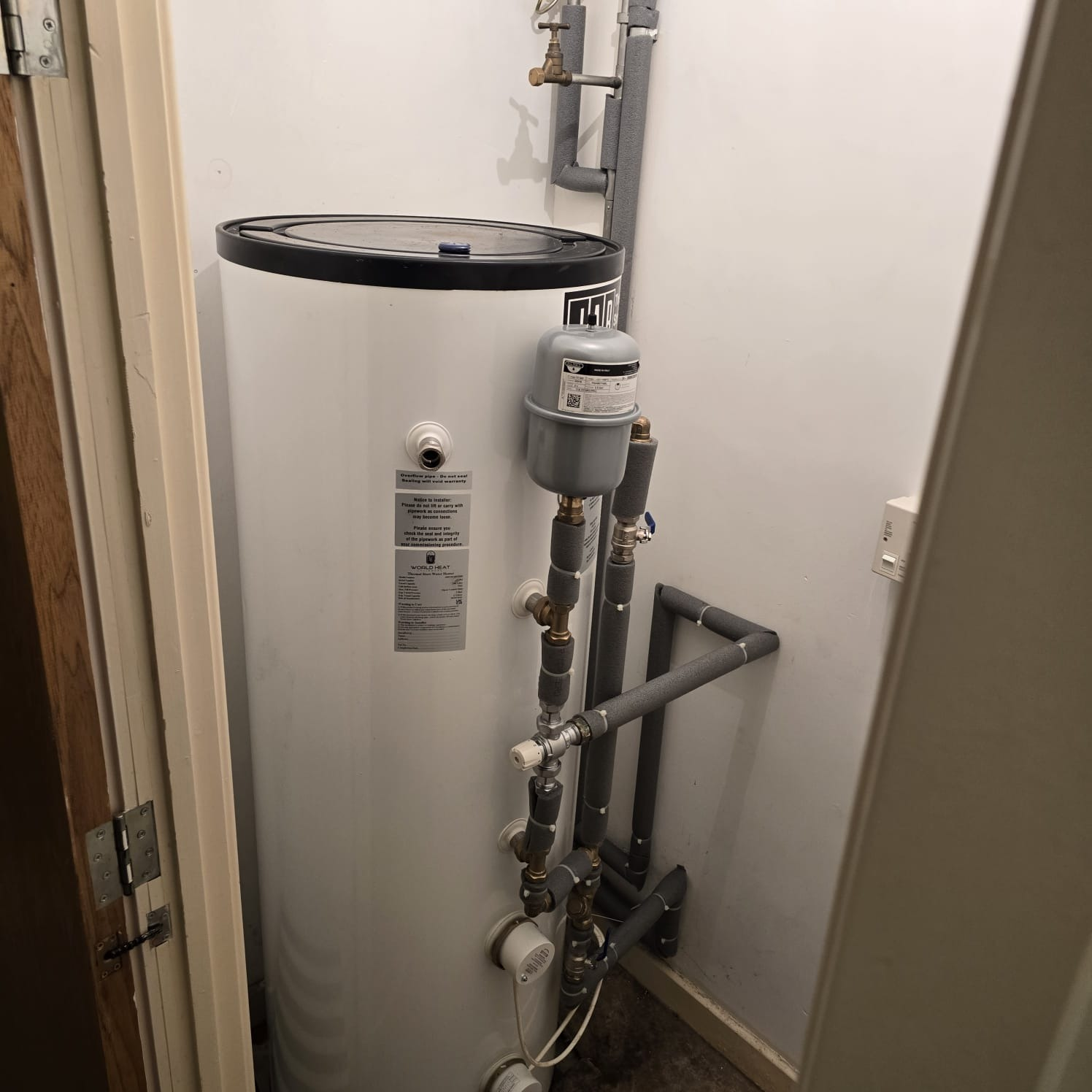
Unvented Cylinders jobs completed across Essex
Photographs from real FHP Heating jobs — no stock imagery. See the full gallery.
Unvented hot water in detail: sizing, safety devices and servicing
Unvented cylinders are one of the most commonly misunderstood parts of a domestic system. This section covers what determines whether one will work in your property, how the safety chain is built, and what an annual service should actually include.
Does your incoming mains support an unvented cylinder?
The single factor that decides whether an unvented system will feel like an upgrade is the incoming cold mains. Pressure alone is not enough — what matters is the flow rate the supply can sustain while several outlets are running. A property with good static pressure but a long, narrow or partially blocked supply pipe will deliver disappointing performance no matter how good the cylinder is.
We measure this at survey, before recommending anything. Where the mains cannot support an unvented system, the honest answer is a different solution — an upgraded supply pipe, a thermal store, or retaining a vented arrangement — and we will say so rather than sell you a cylinder that cannot perform.
- Static pressure and dynamic flow rate measured at the incoming main
- Supply pipe diameter and material inspected, including older lead or narrow-bore runs
- Simultaneous demand assessed across bathrooms, en-suites and utility outlets
- Stopcock condition and isolation checked before any work is priced
Sizing the cylinder to the household, not the cupboard
Cylinder capacity is driven by peak demand and recovery rate, not by what will squeeze into the existing airing cupboard. A family running two showers and a bath in the same hour needs both a sensible stored volume and a coil large enough to reheat it quickly from the boiler.
Undersizing is the most common complaint we are called out to on cylinders fitted by others — the hot water is genuinely at mains pressure, but there is not enough of it. Oversizing has its own cost: a larger volume standing hot, losing heat and using more gas than the household ever needs. Getting this right at survey is what makes the difference between a system you notice and one you never think about.
- Number of bathrooms, en-suites and simultaneous outlets counted
- Peak-hour demand estimated against realistic household usage
- Coil surface area and recovery rate matched to boiler output
- Available space, access route and floor loading checked before ordering
The safety chain: what protects an unvented cylinder
An unvented cylinder is protected by layers of devices, each of which takes over if the previous one fails. The control thermostat holds normal temperature; the overheat thermal cut-out shuts off the heat source if that thermostat sticks; the expansion vessel absorbs volume increase as water heats; the expansion relief valve releases pressure if the vessel cannot; and the temperature and pressure relief valve on the cylinder itself is the final safeguard.
All relief discharge is routed via a tundish — the visible air gap that lets you see when something is passing — into a D2 pipe sized and routed to take near-boiling water to a safe termination. The tundish is deliberately visible for a reason: water running through it is the system telling you a device has operated and needs attention, and it should never be plumbed out of sight.
- Pressure reducing valve setting matched to the cylinder's rating
- Expansion vessel charge set and rechecked against that setting
- Expansion relief and temperature/pressure relief valves function-tested
- Tundish visible and accessible, D2 discharge correctly sized, run and terminated
Annual servicing: what an unvented service should include
An unvented cylinder needs an annual service by a G3 qualified engineer to keep both the safety devices and the manufacturer warranty valid. A service that consists of looking at the cylinder and writing a note is not a service.
Ours includes isolating and recharging the expansion vessel to the correct pressure, function-testing the expansion relief and temperature and pressure relief valves, checking and cleaning the strainer where fitted, verifying stored water temperature and the operation of the overheat cut-out, inspecting the discharge arrangement, checking the immersion heater and thermostat, and recording the work in the Benchmark log so the warranty history stays intact.
- Expansion vessel isolated, drained and recharged to the correct pressure
- Relief valves operated, checked for correct reseating and reset
- Overheat cut-out and control thermostat tested, stored temperature verified
- Immersion, strainer and discharge pipework inspected, results written into the log
Common unvented faults we repair
Most unvented callouts fall into a short list of faults, and most are repairable rather than terminal — provided the cylinder itself has not corroded or scaled beyond use. We diagnose first and quote the repair against replacement so you can see which is worth doing.
Where a cylinder is genuinely at the end of its life, we say so plainly and price the replacement, including any pipework alterations and the discharge route, in the same fixed quotation.
- Water running or dripping from the tundish, usually a flat vessel or a passing relief valve
- Lukewarm hot water from a failed cylinder thermostat, motorised valve or scaled coil
- Fluctuating pressure at the taps from a failing pressure reducing valve
- Immersion heater failure and tripping electrical supply
- Noisy operation and slow recovery caused by limescale in hard-water areas
- Non-compliant discharge or missing safety components on a previous installation
Hard water in Essex and how we protect the cylinder
Much of the Essex supply is hard, and scale is the main long-term enemy of a stored hot water system. Scale forms fastest on hot surfaces, so the heat exchanger coil and any immersion element take the brunt of it, which slows recovery and makes the boiler run longer for the same hot water.
Setting the stored temperature sensibly — hot enough for safety and Legionella control, no hotter than it needs to be — is the first and cheapest protection. Where a property has a history of heavy scaling we will discuss scale reduction options at survey and set out what they will and will not do, rather than adding a product to the quote without explaining it.
Vented, unvented, combi or thermal store
An unvented cylinder is the right answer for many Essex homes but not for every one. A combi boiler suits a single-bathroom property with good mains and no stored-water requirement. A traditional vented cylinder still makes sense where the incoming main is genuinely poor. A thermal store can suit properties combining several heat sources.
We assess the property, the mains, the number of bathrooms and how the household actually uses hot water, then explain the realistic options with the trade-offs of each. The recommendation follows the survey — never the other way round.
Landlords, commercial premises and compliance
Landlords and managing agents have a duty to keep hot water systems safe and in working order, and an unvented cylinder with no service history is an obvious gap in that record. We service unvented systems across let properties in Essex, keep the Benchmark log current, and can carry out the service alongside the annual boiler service and landlord gas safety certificate in a single visit.
On commercial premises the same G3 rules apply, with the addition that stored water temperature and Legionella control need to fit the building's wider water safety arrangements. We work to the specification the building requires and record the results.
Unvented Cylinders questions,
answered straight
Anything not covered here, ring Dean Sone on 07534 068551. The phone is answered 24 hours a day.
What is an unvented hot water cylinder?
It is a sealed hot water cylinder fed directly from the cold mains, so stored hot water is delivered at mains pressure to every tap and shower. Because there is no vent to atmosphere, the system relies on an expansion vessel and a set of relief valves to handle the pressure created as water heats.
Do I need a qualified engineer to install an unvented cylinder?
Yes. Installing an unvented hot water system is notifiable work under Building Regulations Part G3 and must be carried out by an operative holding the relevant unvented hot water qualification. FHP Heating holds G3 unvented cylinder and Water Regulations qualifications, and is Gas Safe registered under number 6075146 for the associated boiler and control work.
How often should an unvented cylinder be serviced?
Annually. The service checks and recharges the expansion vessel, function-tests the expansion relief and temperature and pressure relief valves, verifies the overheat cut-out and stored temperature, and inspects the discharge arrangement. Missing services can invalidate the manufacturer warranty as well as leaving safety devices unchecked.
Why is water dripping from the pipe near my cylinder?
Water running into the tundish means one of the relief valves has operated. The usual causes are an expansion vessel that has lost its air charge, a pressure reducing valve that is passing, or a relief valve that is no longer seating. It is not something to leave — call us and we will diagnose it rather than guessing at a part.
Will an unvented cylinder work with my water pressure?
It depends on the flow rate your incoming main can sustain, not just the static pressure. We measure both at survey before recommending anything, and if your mains cannot support an unvented system we will tell you and set out the alternatives instead.
What size unvented cylinder do I need?
Sizing is based on the number of bathrooms and outlets, how much hot water is used at peak times, and the recovery rate the boiler can deliver through the coil. We size it at survey against your household's actual usage rather than fitting whatever suits the existing cupboard.
Can you replace my old vented cylinder and loft tanks with an unvented system?
In most cases yes, provided the incoming mains supports it. The work involves removing the cold water storage and feed-and-expansion tanks, fitting the new cylinder and its safety group, running a compliant discharge, and rewiring the controls. We confirm feasibility at survey and quote the whole job as one fixed price.
How long does an unvented cylinder installation take?
A straightforward like-for-like cylinder replacement is usually a single day. A conversion from a vented gravity system, involving tank removal, new pipework and a new discharge route, typically takes longer. We confirm the timescale in the quotation so you know how long you will be without hot water.
What guarantee comes with the work?
Every installation carries FHP Heating's 12-month workmanship guarantee, alongside the cylinder manufacturer's own warranty, which we register on completion. That warranty depends on the cylinder being serviced annually by a qualified engineer.
Can you repair an unvented cylinder rather than replace it?
Very often, yes. Expansion vessels, relief valves, pressure reducing valves, thermostats and immersion heaters are all replaceable parts. We diagnose the fault first and price the repair against replacement so you can see which makes sense before deciding.
Do you cover emergencies with unvented cylinders?
The phone is answered 24 hours a day, seven days a week. If a cylinder is discharging heavily, leaking or has left you without hot water, call us and we will advise on isolating the supply safely and get to you.
Which areas do you cover for unvented cylinder work?
FHP Heating is based in Corringham and works across Brentwood, Billericay, Chelmsford, Rayleigh, Benfleet, Leigh-on-Sea, Hadleigh, Basildon and the surrounding Essex towns.
Unvented Cylinders across Essex
FHP Heating is based at 116 Lampits Hill, Corringham, and covers the surrounding Essex towns daily.
Related services
Most jobs touch more than one part of the system. These are the services customers most often book alongside unvented cylinders.
Get a fixed price for your unvented cylinder
Tell us what you have now and what the hot water is doing — weak showers, a dripping tundish, a cylinder with no service history — and Dean will arrange a survey, measure what your mains can actually deliver, and put one written price in front of you before any work starts.
- Gas Safe Register No. 6075146
- £2 million public liability
- 12-month workmanship guarantee