
Heating Controls and Smart ThermostatsInstalled, Wired and Commissioned ProperlySo Your Boiler Only Runs When It Should
A modern boiler on 1990s controls is an expensive appliance being told what to do by a dial. FHP Heating installs and repairs smart thermostats, room thermostats, programmers, zone valves, cylinder stats and thermostatic radiator valves — wired correctly, set up on your Wi-Fi, and explained before we leave.
Gas Safe Register No. 6075146 · 22 years in the trade · 12-month workmanship guarantee on every installation.
6075146
Gas Safe Register number
22 years
In the heating and plumbing trade
12 months
Workmanship guarantee on every job
£2 million
Public liability insurance
24/7
Phone answered, seven days a week
Getting control of when, where and how much your heating runs
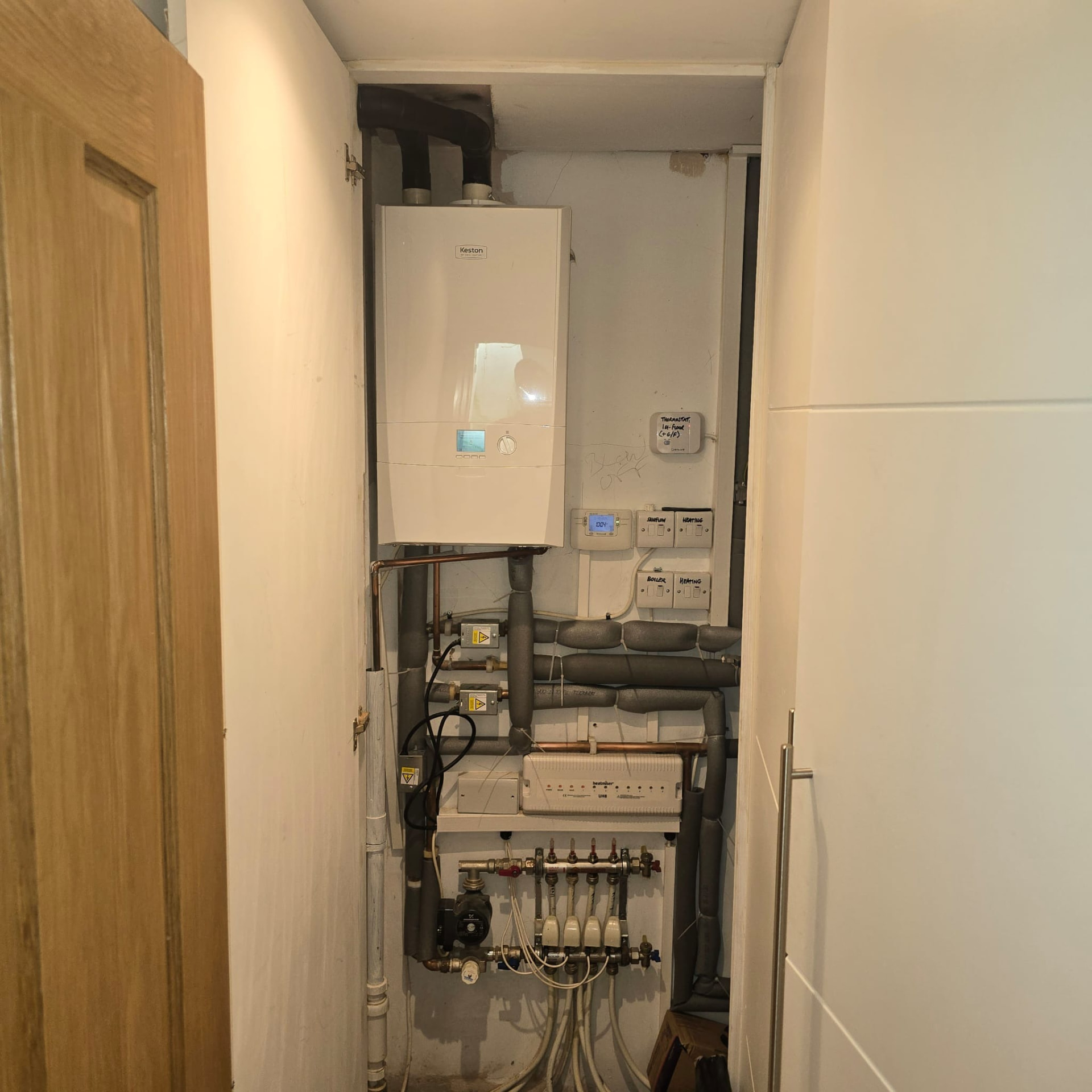
FHP Heating installs, upgrades and repairs the full range of domestic heating controls across Essex and London — smart and Wi-Fi thermostats such as Hive, Nest, Tado and Vaillant's own controls, wired and wireless room thermostats, programmers and timers, motorised zone valves, cylinder thermostats, thermostatic radiator valves and full multi-zone control on larger properties.
What the work actually involves
Identifying the existing control arrangement and wiring centre, confirming whether the boiler supports OpenTherm or simple on/off switching, isolating and removing the old controls, wiring the new controller correctly at the boiler or wiring centre, connecting it to the household Wi-Fi where applicable, then commissioning: proving heating and hot water call correctly, zone valves drive and return, and the schedule behaves as it should.
Who it is for
Homeowners still running a mechanical timer and a single hallway dial, anyone who has bought a smart thermostat and found the wiring is not what the box assumed, households with rooms that are always too hot or too cold, landlords who want a system that a tenant cannot leave running at 25 degrees all winter, and larger properties needing separate upstairs and downstairs zones.
When it is needed
When the heating runs at times nobody chose, when hot water and heating come on together whether you want them or not, when a room thermostat reads several degrees away from the room's actual temperature, when radiators cannot be turned down individually, when a zone valve buzzes or sticks, or alongside a new boiler installation where old controls would hold a modern appliance back.
Why a Gas Safe engineer should do this work
Heating controls are the interface between the electrical side and the gas appliance. Wiring a thermostat into the wrong terminal at a boiler can leave a pump running permanently, prevent a boiler modulating, or cause a fault that looks like an appliance failure but is really a control fault. An engineer who works on the boiler itself, registered under Gas Safe 6075146, commissions the controls against the appliance rather than guessing at the wiring diagram.
Poor controls waste money quietly, every single day
A boiler cannot decide when your house needs heat. If the controls are wrong, the appliance does exactly what it is told — heat the whole house to satisfy one cold hallway, or run all evening because a timer was set years ago and never revisited.
Heating rooms nobody is in
A single thermostat with no TRVs or zoning means every radiator in the property runs whenever the heating calls, including the spare room, the hall and the bedrooms during the day.
A modern condensing boiler never condensing
Efficiency depends on return water temperature staying low. Controls that fire the boiler hard and short-cycle it stop it condensing, so you pay for a high-efficiency appliance and run it at low efficiency.
A thermostat in the wrong place
Fitted above a radiator, in a draughty hallway or in direct sun, a room thermostat reads a temperature that no one experiences and the whole house is regulated on that false reading.
Sticking zone valves
A motorised valve that no longer drives fully open or fails to return leaves heating running when hot water is called, or hot water heating whether needed or not, and it is a common cause of a boiler that will not switch off.
Short-cycling wearing components
Controls with poor hysteresis or an oversized boiler with no load compensation cause frequent firing and stopping, wearing ignition components, fans and diverter valves faster than steady operation ever would.
A smart thermostat that never got commissioned
Half-installed smart controls — connected to the app but not correctly bound to the boiler, or with hot water control never enabled — deliver none of the savings and add a layer of confusion when something goes wrong.
Mistakes that make the bill bigger
- Buying a smart thermostat online and having a general handyman fit it into a wiring centre they cannot read.
- Fitting a smart thermostat while leaving every radiator without a TRV, so the whole house is still one zone with an app on top.
- Leaving the room thermostat in the hallway when the living room is where the household actually is.
- Turning the boiler flow temperature to maximum to make the house heat faster, which stops the boiler condensing and raises the bill.
- Setting hot water to run continuously on a stored-cylinder system rather than on timed heat-up periods.
- Ignoring a buzzing or clicking zone valve until the actuator fails completely and the heating stops entirely.
Five stages from old dial to a system you actually control
Fitting a controller takes an hour. Making it control the boiler correctly, in the right position, with radiators balanced to match, is the part that produces the saving.
-
STEP 01
Survey the system and existing controls
We check the boiler type and whether it supports OpenTherm or modulating control, examine the wiring centre and existing programmer, note where the current thermostat is and whether that position makes sense, and count zones and TRVs.
-
STEP 02
Recommend and fix a price
You get a plain recommendation — which controller suits the system and how you live, whether zoning is worth it, which radiators need TRVs — and one written fixed price before anything is ordered.
-
STEP 03
Install and wire
Old controls removed, new controller wired correctly at the boiler or wiring centre, receiver sited where the signal is reliable, zone valves and cylinder stats replaced where they are part of the job, and TRVs fitted where required.
-
STEP 04
Commission and connect
The controls are tested against the boiler: heating calls, hot water calls, valves drive and return, and the boiler responds and modulates as expected. The controller is connected to your Wi-Fi and the app set up on your phone.
-
STEP 05
Set schedules and hand over
We set an initial schedule around your actual routine, show you how to override it, explain what flow temperature and TRV numbers mean in practice, and leave the manufacturer documentation with you.
What properly commissioned controls change
Controls are the cheapest efficiency upgrade available on an existing heating system, and the one most often left half done.
Heat only where and when you need it
Zoning, TRVs and a schedule that matches your routine stop the boiler heating empty rooms at the wrong times.
Lower gas bills without feeling colder
Better control of flow temperature and run time lets a condensing boiler work in its efficient range instead of firing hard and stopping.
Control from your phone
Smart controls let you turn heating off from a train, warm the house before you arrive, and see what is actually running.
Fewer boiler faults
Ending short-cycling and replacing sticking valves takes strain off ignition components, pumps and diverter valves.
Correct hot water control
On stored hot water systems, a working cylinder stat and timed heat-up periods stop the boiler reheating a full cylinder around the clock.
Set up, not just installed
Wi-Fi connected, app configured, schedules set and the whole thing explained to you before we leave — with a 12-month workmanship guarantee.
Control types, wiring standards and how zoning actually works
There is no single right controller. What suits a two-bedroom flat with a combi is not what suits a four-bedroom house with a cylinder and underfloor heating downstairs.
Smart thermostats, room thermostats and programmers
Smart thermostats such as Hive, Nest, Tado and manufacturer controls from Vaillant, Worcester and Ideal add scheduling, remote control, geolocation and usage reporting on top of a room thermostat. Where the boiler supports OpenTherm or the manufacturer's own protocol, a compatible control can modulate the boiler's output and flow temperature rather than just switching it on and off, which is where the meaningful efficiency gain lives.
A conventional room thermostat and a separate programmer still make sense in plenty of properties, particularly rentals and second homes where an app adds complexity rather than value. What matters more than the badge is placement and wiring: a thermostat on an internal wall in the room the household actually uses, away from radiators, draughts, sunlight and televisions, wired so the boiler receives a genuine demand signal.
- Smart and Wi-Fi thermostat installation
- Wired and wireless room thermostats
- Programmers, timers and time clocks
- OpenTherm and modulating control setup
- Cylinder thermostats and hot water timing
- Thermostatic radiator valve replacement
Zoning, zone valves and multi-zone systems
Zoning splits a property so upstairs and downstairs, or living areas and bedrooms, are heated to different temperatures at different times. Each zone gets its own thermostat and its own motorised zone valve wired through the wiring centre, so a call for heat in one zone does not open the whole system. In larger houses this is the single biggest change you can make to running costs without touching the boiler.
Motorised valves fail in predictable ways: the actuator burns out, the synchronous motor buzzes, or the valve body seizes so the head drives but the paddle does not. Because a failed valve mimics boiler and control faults, we test the valve's drive and its auxiliary switch rather than replacing controls hopefully. Where the valve body itself has seized, the body is replaced rather than just the head.
TRVs, balancing and flow temperature
Thermostatic radiator valves give per-room control and are the cheapest part of any control upgrade, but they only work properly on a balanced system. If lockshield valves have never been set, the radiators nearest the boiler take the flow and the far ones stay cool regardless of what any TRV is set to. We balance the system as part of a controls upgrade so each radiator gets the flow it was sized for.
Flow temperature is the setting most households have never touched and the one that most affects a condensing boiler's efficiency. Running a system at a lower flow temperature for longer periods keeps return temperatures low enough for the boiler to condense, which is exactly what it was designed to do. We set an appropriate flow temperature for your radiators and property and explain the trade-off rather than leaving it at the factory maximum.
Compatibility, existing wiring and older systems
Not every smart control fits every system. S-plan and Y-plan systems, back boilers, systems with no permanent live at the thermostat position, combi boilers without a two-wire thermostat feed and older gravity hot water arrangements all impose limits on what can be fitted and how. We check the existing wiring centre and the boiler's terminals at survey, so the controller we recommend is one that will actually work in your property.
Where wiring is missing for the chosen control, options are a wireless receiver at the boiler, a new cable run, or a different controller that suits the existing wiring. All three get priced honestly rather than the job starting and stopping halfway. On a new boiler installation, we specify controls as part of the design, since manufacturer warranties and efficiency figures increasingly assume modern, compatible controls are fitted.
Heating Controls & Smart Thermostats questions,
answered straight
Anything not covered here, ring Dean Sone on 07534 068551. The phone is answered 24 hours a day.
Which smart thermostat is best for my boiler?
It depends on the boiler and system rather than the brand's marketing. If your boiler supports OpenTherm or a manufacturer protocol, a compatible modulating control gives the biggest efficiency gain. If not, Hive, Nest and Tado all do the job well as on/off controls. We check the boiler at survey and recommend one that suits how your household actually uses heating.
How much does it cost to fit a smart thermostat in Essex?
The price depends on the controller chosen, whether the existing wiring supports it, and whether zone valves or TRVs are being replaced at the same time. We agree one written fixed price before ordering anything, and prices can vary by location.
Will a smart thermostat actually save me money?
It saves money when it is part of a properly controlled system — schedules matched to your routine, TRVs on the radiators, a balanced system and a sensible flow temperature. A smart thermostat fitted on its own, on an unbalanced system with no TRVs, saves far less. That is why we look at the whole control arrangement rather than just the box on the wall.
Can you fit a thermostat if there is no wiring where I want it?
Usually yes, using a wireless thermostat with a receiver wired at the boiler or wiring centre. Where a cable run is preferable we will price that too, and explain the difference before you decide.
My heating comes on when it shouldn't. Is that the thermostat?
Not always. A sticking motorised zone valve, a failed cylinder thermostat or a faulty programmer produce the same symptom. We test the valve drive, the auxiliary switch and the control signals to find which one it is, rather than replacing parts hopefully.
Do I need TRVs as well as a room thermostat?
In almost every case, yes. Building regulations expect both on new installations, and they do different jobs — the room thermostat controls whether the boiler runs, the TRVs control how much heat each individual room takes while it does.
Can you zone my house so upstairs and downstairs are separate?
Yes, on most systems. Each zone gets its own thermostat and motorised valve wired through the wiring centre. We survey the pipework first, because how easily the system splits depends on how it was originally piped.
Do you install controls as part of a new boiler?
Yes. Controls are specified as part of every boiler installation we design, since manufacturer requirements and efficiency ratings assume modern compatible controls, and fitting them at the same time is cheaper than a second visit.
Is the work guaranteed and which areas do you cover?
Every installation carries our 12-month workmanship guarantee, backed by £2 million public liability insurance. We cover Corringham, Basildon, Brentwood, Billericay, Chelmsford, Rayleigh, Benfleet, Leigh-on-Sea, Hadleigh and surrounding parts of Essex, plus London along the A13 corridor.
Heating Controls & Smart Thermostats across Essex
FHP Heating is based in Corringham, and covers the surrounding Essex towns daily.
Related services
Most jobs touch more than one part of the system. These are the services customers most often book alongside heating controls & smart thermostats.
Get controls that match the boiler you already own
Tell us what boiler you have and what your heating does that annoys you, and Dean will recommend the right controls, confirm they will work with your wiring, and give you one written price before anything is ordered.
- Gas Safe Register No. 6075146
- £2 million public liability
- 12-month workmanship guarantee